
- 6. May 2026
- Posted by: Die Redaktion
- Category: READING TIPS
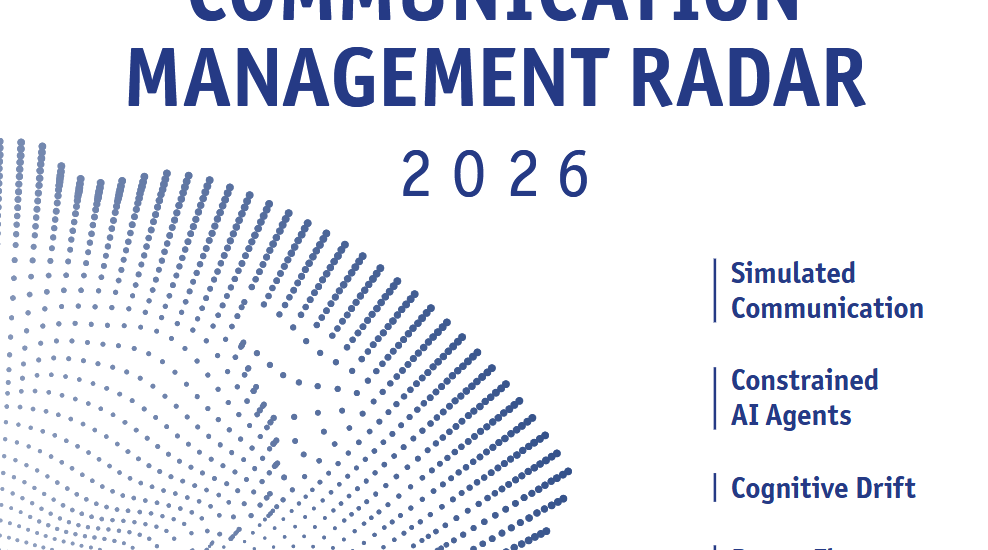
Communication Management Radar 2026
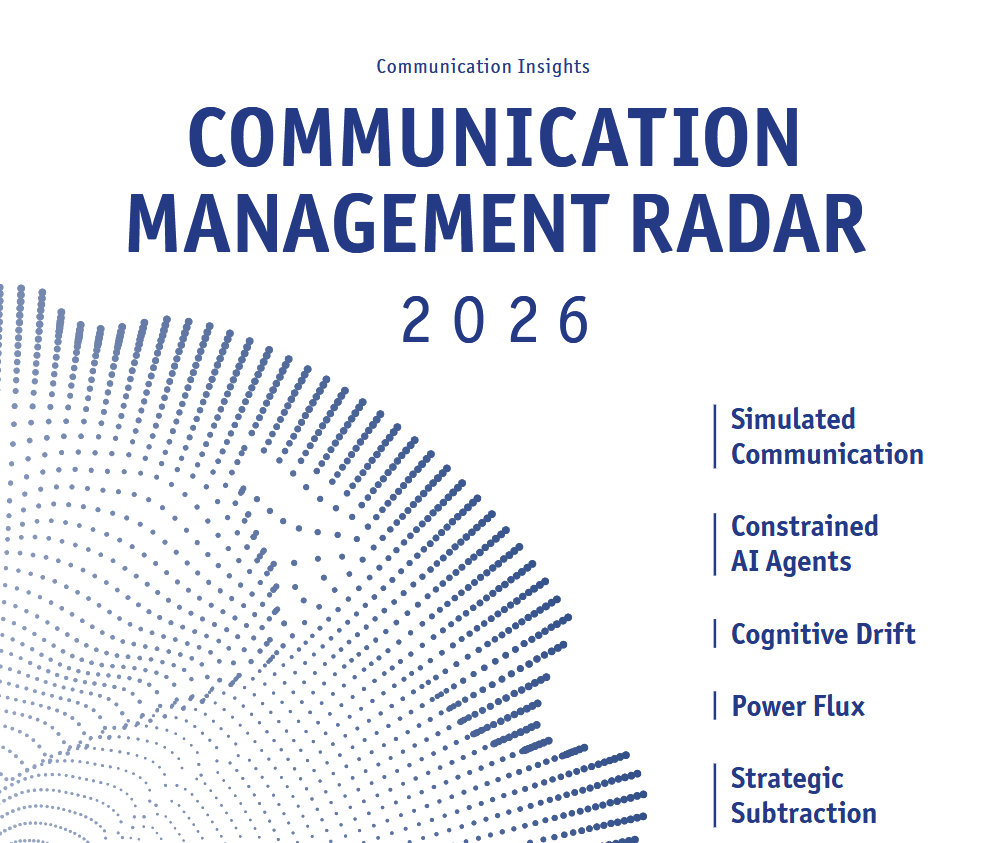
The “Communication Management Radar 2026” by Dr. Michelle Wloka and Prof. Dr. Ansgar Zerfass from the University of Leipzig, published by the Academic Society for Management & Communication, condenses five developments that structure practice on the basis of literature analyses and focus groups with communication managers. The report closely links these observations with concrete approaches to action, which are to be understood more as a shift in work logic than as operational instructions.
It is striking that the recommendations are consistently aimed at stabilization under uncertain conditions. In the context of “Simulated Communication”, for example, it is suggested that content should be geared more towards findability in AI systems and that monitoring should be rethought – no longer as a mere aggregation of data, but as a curated classification. At the same time, the protection of credibility as an independent resource is coming to the fore. Cautious integration is described for dealing with “Constrained AI Agents”: systems should be evaluated along clear application contexts, continuously monitored and embedded in existing responsibility structures instead of being scaled in isolation.
A second focus is on internal skills. In view of “cognitive drift”, the report advocates using AI as a supporting tool without substituting key skills such as critical thinking or judgment. At the same time, “Power Flux” shifts the focus to relationship work: influence is increasingly created through trust, networking and moderation rather than formal positions. In addition, “Strategic Subtraction” focuses on conscious reduction, for example through prioritization, the termination of activities and the coupling of strategy and operational work.