

Where does the communications industry stand in terms of digital transformation?
Digitalization is fundamentally transforming communications work—in companies, agencies, and associations alike. Since 2023, the CommTech Index Report has been tracking this transformation annually using reliable data from the DACH region.
The basis for this is the CommTech Index: a metric ranging from 0 to 100 that describes the maturity level of digital transformation in communications departments and PR agencies. It consists of four components—technology budget, perceived changes, tools used, and data usage in communications. A maximum of 25 points can be earned per component.
The report is published annually by AG CommTech, the DPRG, the PRVA, and ComImpact. It is based on a standardized online survey conducted in Germany, Austria, and Switzerland.
The index consists of:
- Use of the budget for technologies
- Perceived future changes through CommTech
- Technologies used and expected potential of new technologies
- Use of data in communication
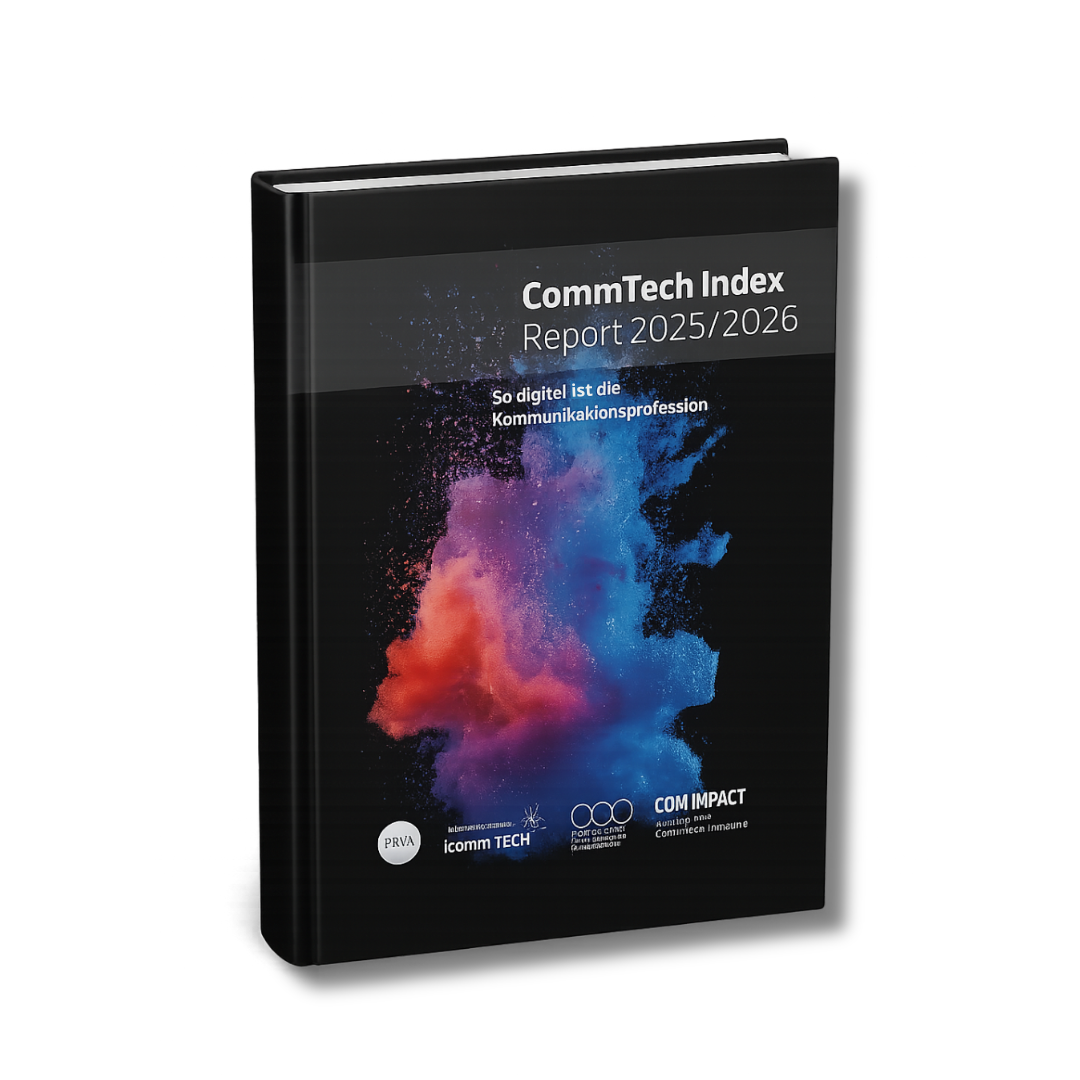
CommTech Index Report 2025/2026: Digitalization Remains a Structural Challenge
; Previous Year: 45
" in the DACH region
are experimenting with AI tools
, the management
The Red Queen Effect Strikes
The CommTech Index drops from 45 to 38 points—not a real step backward, but rather a reflection of a structural problem: The pace of innovation in digital technologies exceeds the industry’s ability to adapt.
Large organizations are pulling aheadPR agencies score 46 points, large communications units 42, and small teams just 35. Digitalization is increasingly becoming a structural competitive advantage for larger units.
AI has become widely adopted, but has hardly been integrated88 percent are experimenting with AI tools—but only 6 percent have actually adapted their processes and structures. Large agencies are leading the way, while regulated industries and small teams are lagging behind.
Technology Adoption: Progress with GapsFor the first time, CRM systems and journalist databases are tied at 46 percent. At the same time, 32 percent continue to use Excel, and 6 percent don’t even use a structured contact management system.
The Gap Between Intent and Implementation Remains WideOnly 10 percent invest more than a quarter of their budget in technology. About 25 percent do not know their own tech budget—small agencies, in particular, are lagging significantly behind.
Impact measurement remains unresolvedMost organizations measure outputs rather than outcomes. The lack of dashboards and data silos prevents consistent performance measurement—numbers are generated, but hardly any actionable insights.
Leadership access is available, but data literacy is lacking75 percent report directly to senior management—a strong indication of strategic importance. However, 39 percent do not have a designated person in charge of data analytics.
The biggest bottleneck is peopleOnly 51 percent consider themselves competent at identifying new technologies. Future-oriented skills such as prompting, curiosity, and change competence are not being systematically developed.
CommTech Index Trends 2023–2026
Scale 0–100 · Sample size: 507 respondents (2025/26), 352 (2024), DACH region
This decline does not represent a real step backward, but rather reflects the “Red Queen Effect”: Organizations must run faster and faster just to stay in place amid technological change. While tools, AI capabilities, and system landscapes are evolving at a rapid pace, the industry can no longer keep up with its own adaptation and learning processes. What was considered progress yesterday seems inadequate today—digitalization is now viewed more realistically as a long-term transformation process.
Index by Organization Size
Large organizations are pulling ahead: PR agencies and large communications departments are clearly setting themselves apart from small teams. The gap between large and small is widening—digital transformation is becoming a structural competitive advantage.
AI Adoption: Experiment vs. Integration
88 percent are experimenting with AI—but only 6 percent have actually adapted their organizational structure. The industry is still in the early stages of true transformation. There is curiosity, but a lack of structural integration.
Sample: 507 respondents · DACH region · 2025
Major Barriers to the Adoption of New Technologies
Traditional technical hurdles are increasingly giving way to soft factors: IT governance, change management, and a lack of skills management are becoming the real bottlenecks. System integration remains the single biggest hurdle—followed by a lack of skills within the team.
Multiple responses allowed · Sample: 386 respondents in communications departments · 2025
Find out more about the Index Report here
AI is inspiring – but not (yet) in everyday life: why there is currently a gap between hype and reality
No breakthrough – Thomas Mickeleit presents the CommTech Index Report 2024/2025 in the “Yellow Pages”.
All Reports Available for Download
The CommTech Index Report is published annually. Here you can find all previous issues as free downloads.