
- 3. March 2026
- Posted by: Reimer Stobbe
- Category: NEWS
The article was written by: Maike Molling, Jörg Forthmann and Reimer Stobbe
Results from the survey in the “Strategy and impact measurement” cluster
The current survey in the “Strategy and impact measurement” cluster reveals an exciting yet contradictory picture. The 19 participants set clear priorities: KPI frameworks, ROI calculation, AI tools for impact measurement and dashboards in particular are at the top of their agenda. These areas are seen as key levers for demonstrating the impact and value contribution of communication more convincingly in future.
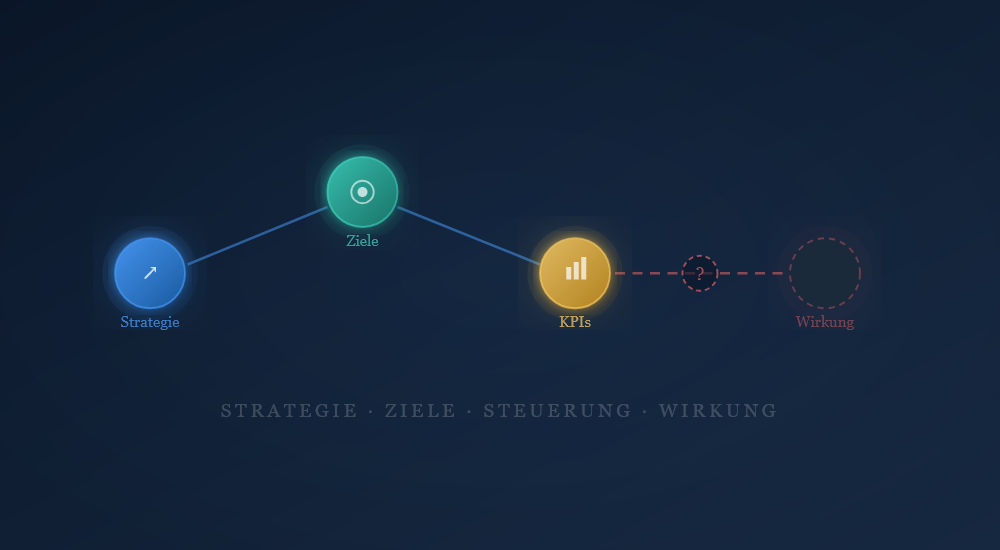
At the same time, many already rate strategic management in their organizations as relatively well-developed. However, the detailed analysis of the open answers suggests that the practical implementation of this management is often still on shaky ground. In technical terms, strategic management means translating corporate goals into a clear cascade of objectives, backing these up with KPIs and impact levels and making data-based decisions. However, it is precisely these elements that are missing in many places – the participants themselves are surprisingly open about this. “There is a lack of KPIs for controlling,” is one response. Another comments: “Allocation of operational requests to strategic objectives.” Structural problems also become clear, such as “No common dashboard, no benchmarks” or “The central challenge is less communicative than organizational. Strategy, structures and decision-making logic must be synchronized.”
A similar picture emerges on the impact measurement side. Many want valid methods, a better database and acceptance by management. “To finally be able to prove the impact in a way that is accepted by management,” is one quote. Others speak of a lack of methodology or very practical hurdles such as “data consolidation”, “data basis” and “collecting, visualizing and then presenting data in a sensible way”. It is also striking that while KPI frameworks and ROI calculation are considered top issues, only 21% rate integrated data management as a high priority – even though it is a prerequisite for all these objectives. At the same time, the database repeatedly appears as a pain point in the open responses.
The preferred exchange formats show a clear direction: the participants primarily want team meetings with impetus and discussion, supplemented by webinars for the basics. And they show a remarkable willingness to collaborate – especially when it comes to setting up an AI library, which is almost perceived as a joint flagship project with 84% approval.
Where does the shoe pinch in particular? The participants describe four main problem areas: a lack of strategic clarity (“Unclear strategy of the company”), organizational obstacles (“Responsibilities”; “Ad hoc assignments … difficulty in not appearing as a recalcitrant service provider”), challenges with data and methodology and a high level of expectation pressure (“Stakeholders often expect results too quickly”). These passages clearly show that many teams want to work strategically but do not yet have a consistent management model that systematically combines strategy, impact measurement, data architecture and governance.
For communicators, this results in a clear field of development: if you really want to put strategic management into practice, you need valid KPIs, a functioning results chain, a stable data architecture and a comprehensible link between communication goals and corporate goals. Without this foundation, strategic management remains more of a declaration of intent than a robust management tool.
The results of the survey fit in seamlessly with the findings of the CommTech Index 2025/26, which also shows that many communications departments are striving for strategic impact orientation – but often still lack the basic infrastructure, measurement logic and data integration to consistently meet this requirement.
The CommTech Academy seminars provide answers to many unanswered questions.
The head of the “Strategy & Impact Measurement” cluster, Maike Molling, Jörg Forthmann and Reimer Stobbe, will use the results to develop interactive formats for the cluster members. A dedicated team channel for the community has already been set up.