

- 24. September 2026
- Posted by: Britta Pesch
- Category: BEST PRACTICES
The assistant provides answers; the agent delivers results
Agentic AI promises more than just faster text generation: AI agents can independently execute processes, connect systems, and prepare results. For communications departments, this transforms the way they work, their roles, and leadership. In an interview based on a CommTech Academy webinar, Martin Regnet and Christof Schmid explain why Agentic AI is not just a tool project, where robust use cases lie, and why people will become not less important—but important in a different way—in the new communications operating system.
AG CommTech: Christof, what distinguishes an AI agent from a traditional AI assistant?
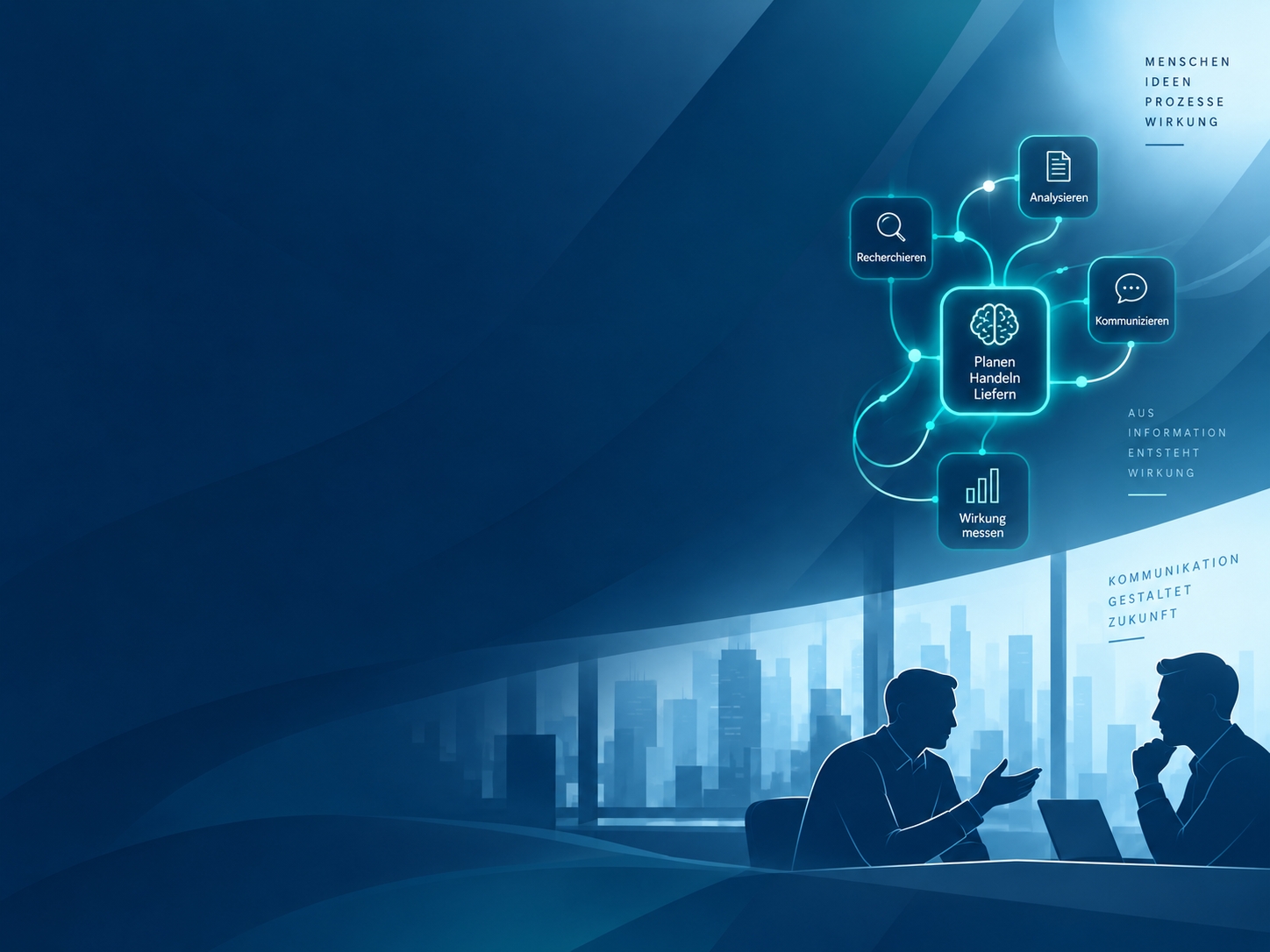
Christof Schmid: The key difference is autonomy. An assistant waits for my prompt. An agent, on the other hand, is given a goal and largely figures out how to achieve it on its own. It plans, accesses tools, data, and connected systems, and can correct itself through iterative loops. To put it simply:
The assistant focuses on the answer; the agent focuses on the result.
Christof Schmid
For us, three characteristics are key: An agent is event-driven, follows process logic, and makes goal-oriented decisions. That is why we must also define what the AI is allowed to do and at what points humans exercise control and give approval.
AG CommTech: Martin, is Agentic AI really a new paradigm for corporate communications?
Martin Regnet: In my view, yes. Many communications departments still operate like a traditional manufacturing facility today: there are silos and disconnects. Technologically, however, we’re moving toward a different model. Our vision for 2030 is a networked communications operating system in which teams access shared data and agents support or take over processes in the background. That doesn’t mean everything should be automated. The real change lies in the interconnection of processes, data, and roles, as well as greater transparency.
AG CommTech: Why is productive use still relatively limited, then?
Martin Regnet: The technology is often not the main problem. From our perspective, the key factors are enablement, strategic leadership, and resources. Teams need training and room to experiment. At the same time, there needs to be a clear vision and a decision on where Agentic AI should be used effectively. Working hours and budget must also be factored in. Agentic AI is therefore a leadership issue and not primarily a question of tools.
AG CommTech: Many teams are constantly experimenting with new applications. When does this become a problem?
Martin Regnet: A willingness to experiment is important at the beginning. It becomes problematic when it turns into a permanent “tool zoo.” Often, a few tech-savvy individuals drive the development, while the rest of the team lags behind. Then you have to ask: Which processes create the greatest long-term value? Which agents do we really want to operate and integrate? The goal shouldn’t be using multiple tools, but rather an increasingly integrated operating system. This requires prioritization and a shared vision.
AG CommTech: Christof, where do you see compelling areas of application today?
Christof Schmid: Processes in which large amounts of data are processed, events trigger a sequence of actions, and multiple steps follow one another are particularly interesting. In real-time crisis management, monitoring can set a trigger, an agent can process information, and stakeholders can be involved at an early stage. Another use case is media training—from preparation and simulation to the evaluation of messages. It also plays a very concrete role in managing media inquiries: An inquiry can be analyzed, broken down into individual questions, cross-referenced with corporate knowledge and approved messages, and compiled into a draft response.
AG CommTech: Will press inquiries then be answered automatically in the future?
Christof Schmid: That would be the wrong conclusion. The key lies in significantly accelerating research, structuring, and drafting. Final responsibility remains with humans. That’s why the Human Governance Layer is central: humans review and approve the response. Approved responses can then be fed back into the Knowledge Layer. This creates a learning loop. A robust knowledge base—such as a messaging or “one-voice” library—is essential. Without reliable context, even a powerful agent cannot deliver reliable results.
AG CommTech: Martin, how does a communications department identify the right use cases?
Martin Regnet: We recommend a systematic evaluation. In our decision matrix, we consider operational value contribution and communication impact, as well as feasibility, day-to-day operations, risk, and governance. This allows us to distinguish quick wins from strategic projects. Next, a roadmap is needed. IT, Legal, the works council, and Marketing should be involved early on. Capacities and the budget must be planned realistically. And Agentic AI should be viewed as a continuous process: measure, learn, validate, and adjust.
AG CommTech: Does this mean that every communication process must first be fully documented?
Martin Regnet: In my view, process clarity and documentation are essential prerequisites. But you don’t have to wait until the entire department is perfectly documented and all data has been curated. You can start with a clearly defined area where processes and data are sufficiently organized. This area can then become a building block for a future operating system.
Christof Schmid: I would caution against treating comprehensive process documentation as the be-all and end-all. A good starting point is to let the people involved speak for themselves: Where are the bottlenecks today? Which workflows are cumbersome? Where do unnecessary loops occur? This often quickly reveals which processes are worth focusing on. Then you select a few cases, articulate them clearly, and evaluate the options. You have to take a structured approach—but you also have to get started.
AG CommTech: How does this change the job profile?
Martin Regnet: We describe this development as a shift from “doer” to “orchestrator.” As agents take over operational steps, humans increasingly become the control and governance authority in a hybrid human-AI system. They verify quality and are responsible for decisions. This gives rise to new areas of responsibility: Agent Orchestrator, Agent Builder, Agent Ops, and the “human-in-the-loop.” So humans aren’t disappearing from the process. Their role is shifting from production to orchestration and accountability.
AG CommTech: Christof, how much AI expertise will leadership need in the future?
Christof Schmid: It won’t work without the basics of AI. A leader doesn’t have to be able to build every agent themselves. But they should understand how an agent works, how the layers interact, and what delegation to AI entails. After the experimentation phase, leadership is needed to formulate a strategic goal and provide direction. This also involves having experienced the possibilities firsthand. Only then can one decide where autonomy makes sense and where boundaries are necessary.
AG CommTech: Does this make humans more important or less important?
Christof Schmid: In a certain sense, yes. I see the danger that AI results will be passed on without really being verified. That is exactly what must not happen. We’re here to make decisions, evaluate results, and take responsibility. Moreover, communication isn’t just about efficiently produced content. People bring emotion and storytelling to the table. That remains at the heart of our work. The more AI becomes integrated into our processes, the more clearly we need to define this human role.
What’s possible, and where are the limits? Download for free.
Go to the white paperWith Martin Regnet and Christof Schmid at the CommTech Academy.
Register nowAG CommTech has published a white paper titled “AI Agents in Corporate Communications—What’s Possible, Where Are the Limits,” which is available . Martin Regnet and Christof Schmid will co-host an online seminar on October 27, 2026, at the CommTech Academy; you can register for it here . The participation fee is 490 EUR net.